SaaS makers · Referral programs
When should your SaaS give the referrer their $20 credit?
Tie the reward to a paid invoice, not a signup. In a hypothetical month with 60 referred signups, paying both sides at signup costs $125 per customer still paying in month three. Waiting for the friend’s first payment cuts that to $50.
GimmeTheSauce editorial ·
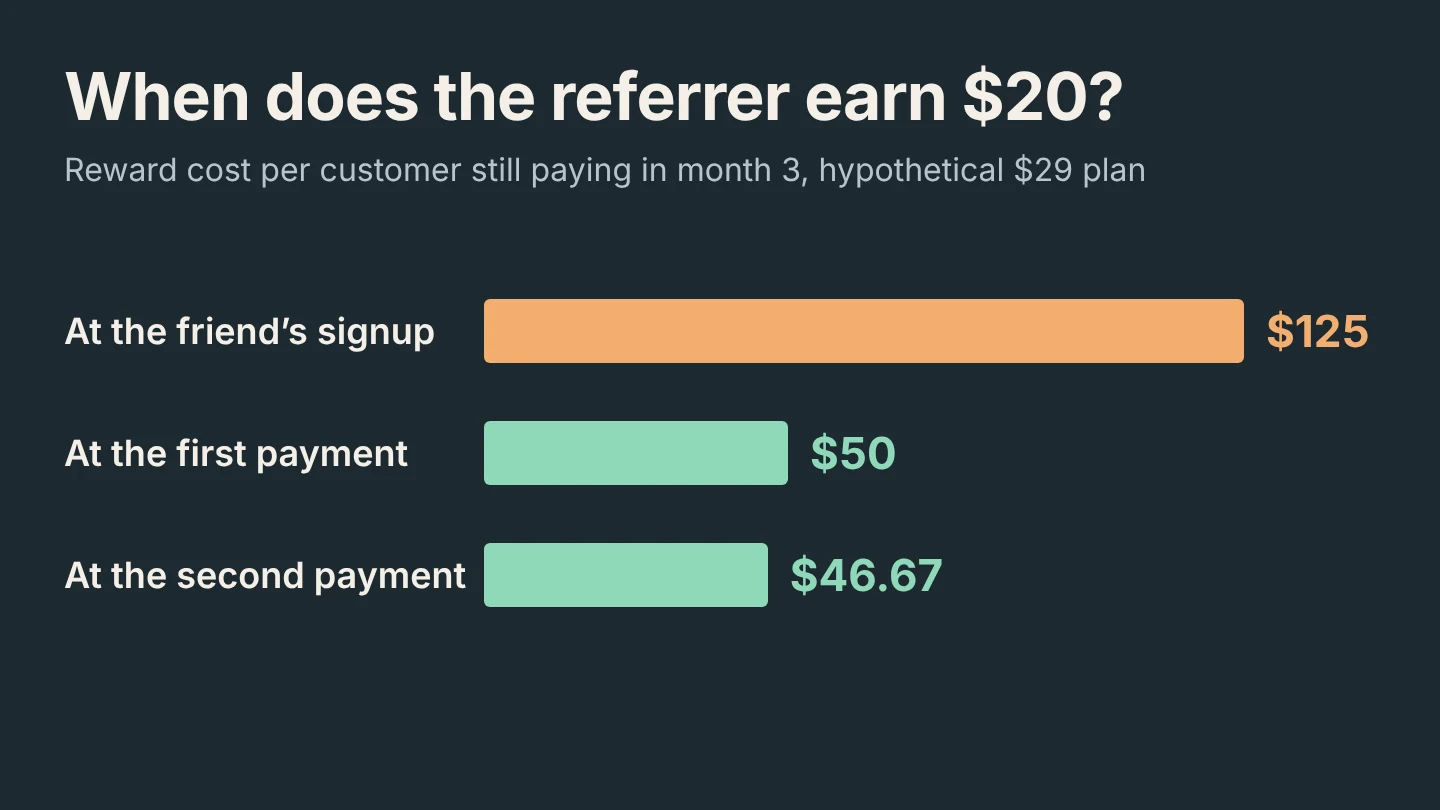
Give the referrer their credit when the friend’s first paid invoice succeeds, not when the friend signs up. A signup costs you nothing to fake and often never turns into revenue. In the hypothetical month below, the same two-sided $20 offer costs $125 per customer still paying in month three if both rewards go out at signup, and $50 if the referrer waits for the friend’s first payment.
Set up the offer
Suppose a SaaS plan costs $29 a month. A referred friend gets $20 off their first invoice. The referrer gets a $20 credit toward their own next invoice.
In Stripe, a promotion code can carry the friend’s discount. Its first_time_transaction restriction limits it to customers with no prior payments or non-void invoices. The referrer’s reward can be a credit in their customer invoice balance, which applies automatically to their next finalized invoice, up to that invoice’s total. A $20 credit on a $29 plan means the referrer pays $9 next month. Stripe’s promotion code restrictions · Stripe’s customer invoice balance
The first-time check looks at the Stripe customer. It cannot tell that a new account with a new email belongs to an existing customer. Decide how you will review self-referrals, and cap credits per referrer, before you announce the offer.
Follow one referral month
In this hypothetical month, 60 referred people sign up. Fifteen pay their first, discounted invoice. Thirteen pay a second, full-price invoice, and 12 are still paying in month three.
| Referrer earns the credit at | Friend discounts | Referrer credits | Total | Per customer still paying in month 3 |
|---|---|---|---|---|
| Friend’s signup | 15 × $20 = $300 | 60 × $20 = $1,200 | $1,500 | $1,500 ÷ 12 = $125.00 |
| Friend’s first payment | $300 | 15 × $20 = $300 | $600 | $600 ÷ 12 = $50.00 |
| Friend’s second payment | $300 | 13 × $20 = $260 | $560 | $560 ÷ 12 = $46.67 |
Discounts appear only on the 15 first invoices that were actually paid. With a signup trigger, the referrers of the 45 people who never paid still collect $900 in credits.
Waiting for the second payment saves only $40 more here, and it delays the thank-you by a month. The bigger decision is between a signup and a payment. If your refunds are common, wait until your refund window has passed for that first invoice.
Compare it with your other channels
Over three months the 15 paying customers bring in 15 × $9 = $135 in the first month and (13 + 12) × $29 = $725 after that: $860 before payment fees and taxes. The first-payment version spends $600 in discounts and credits to get them. Whether that is a good trade depends on how long those 12 keep paying, and what the same customers would cost through another channel. Run the same break-even check you would use for a creator deal, with credits counted as a cost.
Count referred customers as their own cohort. Don’t assume they keep paying longer than other customers until your own months show it.
Launch with a narrow version
Start with existing customers who have paid at least once, a clear cap per referrer and a written rule for what earns a credit. Before you widen the offer, check three numbers: paid first invoices per referred signup, credits issued per retained customer, and refunds or flagged self-referrals.
Bring your plan price, expected funnel and fraud checks to Marc Louvion’s AI mentor to pressure-test the offer ↗. Use counts, not customer names or emails.