App and SaaS makers · Creator deal economics
Is $600 plus 20% cheaper than a $1,000 creator fee?
With $36.72 of net receipts per payer, a $600 retainer plus 20% costs less below 55 payers. But the hybrid still needs 26 payers to cover its own costs. Work out both thresholds before choosing the deal.
GimmeTheSauce editorial ·
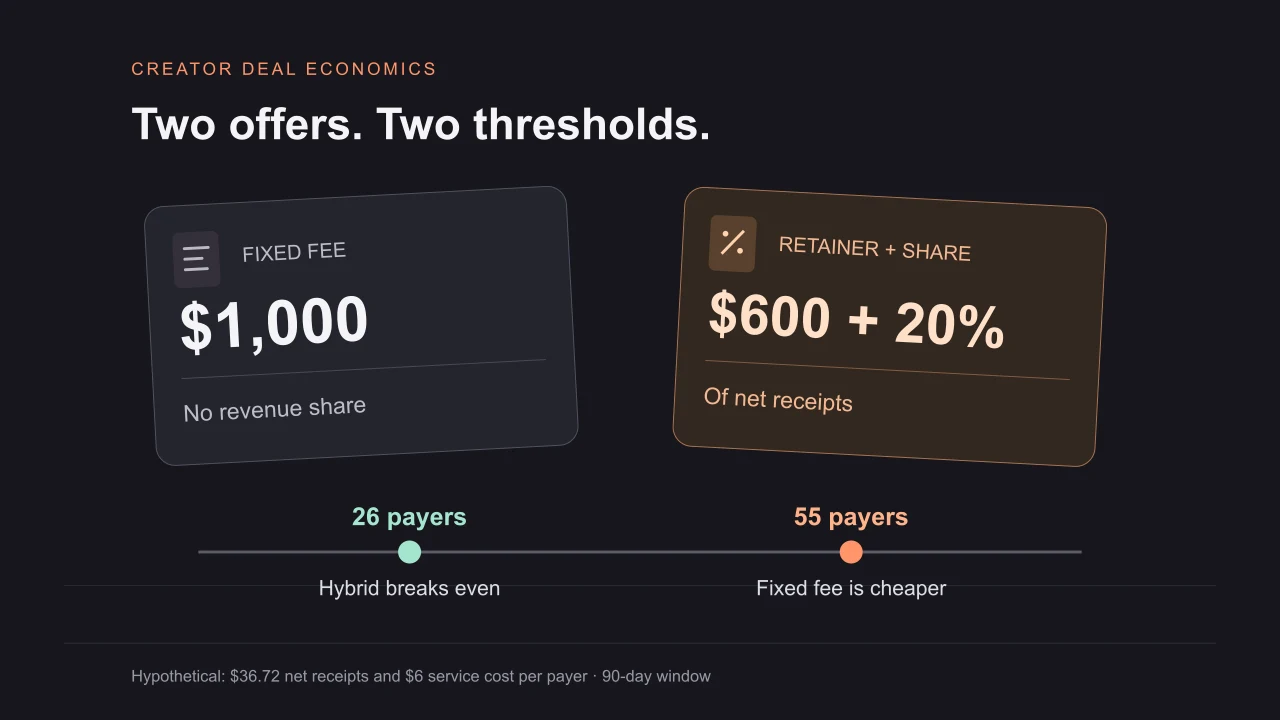
A $600 retainer plus 20% of net receipts is cheaper than a $1,000 fixed fee only while the creator’s revenue share stays below $400. With the hypothetical $36.72 net receipts per payer used here, the fixed fee becomes cheaper at 55 paying customers. That does not mean the hybrid is profitable below 55: it needs 26 payers just to recover its own costs.
Use the Creator Deal break-even calculator to change the fees, revenue-share basis and payer count. The first question is whether a deal covers its costs. The second is which acceptable deal costs less.
Give every payer the same revenue window
Imagine one month of creator work followed by a 90-day revenue observation for each acquired payer. The example is invented, not a market rate or a creator result. Each payer generates $48 in cumulative gross receipts, 10% is refunded, platform fees are 15% of the remaining receipts, and the service costs total $6 per payer over that window. We exclude sales tax and company overhead.
The arithmetic is:
- After refunds: $48 × 90% = $43.20.
- After platform fees: $43.20 × 85% = $36.72.
- Before creator compensation: $36.72 − $6 = $30.72 contribution per payer.
Choose a revenue window your data can support. Do not compare a creator whose customers have paid for three months with another whose customers arrived last week. RevenueCat distinguishes revenue per customer from revenue per paying customer and marks incomplete cohort periods. Map the denominator to the input before copying a dashboard value. RevenueCat’s cohort definitions
If your recent customers are mostly still trying the app, account for trial maturity first. A signup or trial start is not the paying customer used in this example.
Calculate the two thresholds separately
Under the hybrid, the creator receives 20% × $36.72 = $7.344 per payer. That leaves $23.376 after the $6 service cost. Keep the precision during the calculation, then round the required customer count up:
$600 ÷ $23.376 = 25.67, so 26 paying customers are required.
Under the $1,000 fixed fee, there is no variable share. The threshold is $1,000 ÷ $30.72 = 32.55, or 33 payers.
| Paying customers | Contribution after $1,000 fixed fee | Contribution after $600 + 20% |
|---|---|---|
| 20 | −$385.60 | −$132.48 |
| 50 | $536.00 | $568.80 |
| 100 | $2,072.00 | $1,737.60 |
Now compare creator compensation alone. The extra $400 fixed fee buys out a $7.344-per-payer obligation within this window. $400 ÷ $7.344 = 54.47. At 55 whole payers, the fixed fee is cheaper. This comparison holds customers, receipts, costs and deliverables constant; different incentives can change the actual performance.
“Twenty percent” needs a written basis
If the share instead applies after refunds but before platform fees, it becomes 20% × $43.20 = $8.64 per payer. The hybrid leaves $22.08 per payer and needs 28 payers to cover the $600. The fixed-fee crossover moves to 47 payers. The same headline percentage now means a different deal.
Before evaluating an offer, specify the receipts used, refund treatment, included renewals, attribution window, payout duration and who resolves duplicate claims. RevenueCat’s creator measurement guide separates the attribution decision from commission and payout rules. Those rules need agreement before launch. Measuring and paying creator campaigns
Platform reports also differ in attribution methodology, timing and lookback windows. Do not add two platforms’ claimed conversions and call the total new customers. Attributed sales alone do not establish incremental sales. TikTok’s reporting differences
At this point, review the deliverables and downside with Julia Pintar’s AI mentor ↗. Bring the proposed terms and the calculation, not only the creator’s follower count.
Turn the threshold into a small decision
Compare the same three payer counts for your own offer: a weak result, your working assumption and a stronger result. Agree what content will be delivered and when the first reporting checkpoint is useful. If the economics require 26 payers but you have no evidence connecting the creator’s audience to purchases, that is the uncertainty to test. A large view count does not settle it.
For a view-to-download assumption, check the source and denominator, then use Views → MRR to explore the acquisition funnel. If the issue is paying the retainer before subscription money arrives, inspect the cash timing; a positive 90-day contribution is not cash available today.
Finally, do not treat the 90-day comparison as the full cost of a lifetime revenue share. Renewals beyond the window can change the preferred offer. Revisit that obligation separately before signing, along with rights, exclusivity and the creator’s ability to make useful content.