App and SaaS makers · Subscription offer economics
Should you offer $10 monthly or $60 annually?
The annual offer collects six times as much at the first payment, but it does not automatically earn more. In this worked example, monthly contributes $59.28 per starting payer versus $39 annually; changing monthly renewal loss reverses the result.
GimmeTheSauce editorial ·
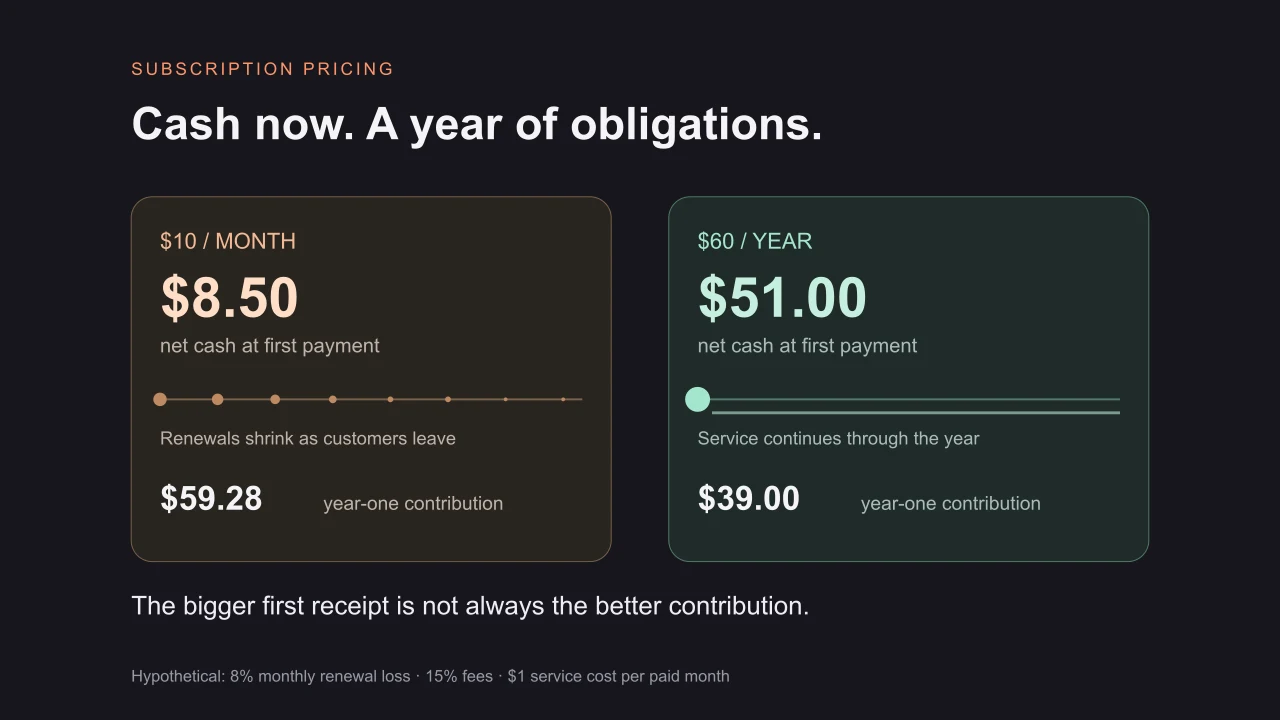
A $60 annual offer is a 50% discount against twelve $10 monthly payments. It also collects six times the gross amount at the first payment. Neither observation tells you which offer contributes more over a year. For that, count how many monthly renewals you expect and what each paid month costs to serve.
In the hypothetical example below, a monthly payer contributes $59.28 in the first year and an annual payer contributes $39. Increasing monthly renewal loss from 8% to 20% reverses that result. Use the Subscription Pricing calculator to compare your own offer mix; these inputs are invented, not plan benchmarks.
Hold the customer horizon fixed
Start one new paying customer on November 1. Compare the period up to, but not including, the following November 1. There are no trials, refunds, upgrades or new customers in this example. Prices exclude sales tax. Each offer has a hypothetical 15% fee and a $1 service cost for every month of paid access.
The annual plan charges $60 at the start. It leaves $51 after fees and must fund twelve months of service. That gives $51 − $12 = $39 contribution before acquisition and company overhead. The first annual renewal is outside this horizon, so changing annual renewal loss cannot affect this first-year result.
Do not call the $60 charge $60 of MRR. Its monthly-equivalent recurring revenue is $5. Cash collection and earning revenue over a service period are distinct; Stripe’s subscription examples show that timing explicitly. The calculator is a planning model, not an accounting system. Stripe’s subscription revenue methodology
For an App Store offer, use the fee that actually applies to your program and subscription circumstances. The example’s 15% is not a universal deduction. Apple’s subscription terms
Count monthly renewals before comparing the discount
With 8% lost at every monthly renewal, the expected paid months are:
1 + 0.92 + 0.92² + … + 0.92¹¹ = 7.90417.
Each paid month leaves $10 × 85% − $1 = $7.50 after fees and service. Multiply $7.50 by 7.90417 to get $59.28 contribution per starting payer. Fractional expected payments describe a cohort average, not a partial invoice for one person.
| First-year comparison | $10 monthly | $60 annually |
|---|---|---|
| Net cash at first payment | $8.50 | $51.00 |
| Starting gross MRR | $10.00 | $5.00 |
| Expected paid service months | 7.90417 | 12 |
| Contribution after fees and service | $59.28 | $39.00 |
The annual plan is easier on immediate funding but gives up contribution under these assumptions. To match the monthly contribution while funding twelve months of service, the annual price would need to be about ($59.2813 + $12) ÷ 85% = $83.86, roughly a 30.1% discount from $120.
That is a cost-equivalence calculation. It is not evidence that customers will accept $83.86 or that a 30% discount is optimal.
Change the assumption that can reverse the answer
At 20% monthly renewal loss, expected paid months fall to 1 + 0.8 + … + 0.8¹¹ = 4.65640. Monthly contribution becomes $34.92, below the annual offer’s $39. Annual now contributes more within the first year, with all the other example inputs held fixed.
Use the correct renewal boundary. An 8% weekly loss is much more frequent than an 8% annual loss. A cancellation request also need not end paid access immediately; map requests to the actual end of access before estimating renewals and service costs.
If service costs are driven by AI usage, check heavy users separately. Collecting a year upfront does not eliminate a costly service obligation.
Once those inputs are explicit, review the offer comparison with Marc Louvion’s AI mentor ↗. Bring the service cost and renewal evidence alongside the prices.
Test the offer people actually choose
The calculator can split new customers between up to four offers, then let their active mix evolve as renewals differ. A 70% monthly / 30% annual acquisition mix is not a permanent 70% / 30% mix of active subscribers. Do not copy an active-subscriber share from another model into this new-customer input without checking the denominator.
Before changing a live offer, write down the decision: more first-purchase conversion, earlier cash or more contribution per eligible visitor over a stated horizon. Track which eligible users saw the offers, who paid, what they chose and what happened as their cohorts matured. Hold the measurement definition steady; price changes can also change the audience and behavior.
Keep future obligations visible. Within-horizon cash contribution excludes service after the comparison ends, particularly when a weekly charge falls near the boundary. For ongoing retention, compare a longer horizon. For an acquisition-funding question, inspect the campaign’s cash payback. The most attractive first receipt is only one part of a sustainable offer.