App and SaaS makers · AI pricing and usage
Can your $20 AI plan afford its heavy users?
A hypothetical $20 plan has a 64.75% blended contribution margin while each heavy user loses $7.30. Count retries and free usage before setting a cap; a healthy average can hide an expensive segment.
GimmeTheSauce editorial ·
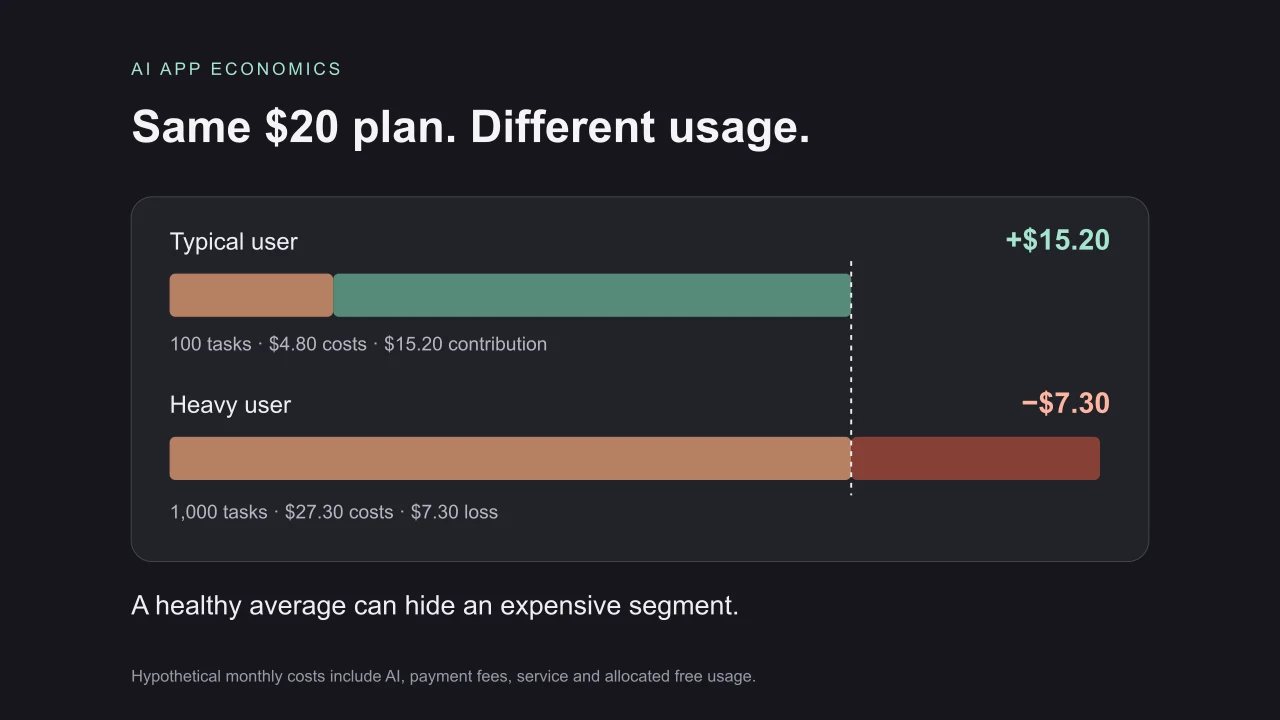
Before calling a $20 AI plan profitable, calculate a heavy user separately from the average. In the hypothetical example below, the plan retains 64.75% contribution margin overall, but a heavy user costs $7.30 more than their subscription brings in. A larger share of those users can change the economics without a single provider price increase.
The AI App Profit calculator reproduces the example and lets you change the usage mix. It uses your costs; it does not silently substitute a current model price or an industry benchmark.
Start with a completed task
Suppose the app completes a useful document-processing job. Its AI pipeline costs $0.02 per billable attempt, and retries or failed attempts bring the average to 1.25 attempts per completed job. Each completed job therefore costs $0.025.
That cost is invented for this example. To replace it, choose a representative period, reconcile the provider invoices and count the attempts. Include every model call and billed tool used to complete the job. Provider pricing can distinguish input, output, caching and feature-specific charges; a model’s headline token price is not the total application cost. Anthropic’s pricing documentation
There are two valid input methods. Invoice cost divided by billable attempts needs an attempts-per-completed-task multiplier. Invoice cost divided by completed tasks already includes failed work, so its multiplier should be one. Applying retries twice inflates the estimate.
Before counting a successful HTTP response as a job, define the useful result the customer actually repeats. An empty export and a completed document should not be interchangeable successes.
Put the free users in the same ledger
Assume 100 paying users at $20 per month. Ninety complete 100 tasks each; ten complete 1,000 each. Another 400 free users complete five tasks each. All groups use the same cost per task in this simplified model.
| Monthly line item | Calculation | Amount |
|---|---|---|
| Paying-user AI work | (90 × 100 + 10 × 1,000) × $0.025 | $475 |
| Free-user AI work | 400 × 5 × $0.025 | $50 |
| Payment fees | 100 × ($20 × 5% + $0.30) | $130 |
| Other paid-user service costs | 100 × $0.50 | $50 |
| Revenue | 100 × $20 | $2,000 |
| Contribution before overhead | $2,000 − $475 − $50 − $130 − $50 | $1,295 |
Contribution margin is $1,295 ÷ $2,000 = 64.75%. Subtract another hypothetical $100 of fixed overhead and $1,195 remains before acquisition costs and tax. The fee assumptions are not quoted processor rates. Prices exclude sales tax; refunds and annual billing are outside this monthly example.
Now allocate the $50 free-user AI bill across 100 payers: $0.50 each. A typical payer leaves $20 − $1.30 payment fees − $0.50 service costs − $0.50 free allocation − $2.50 AI usage = $15.20. A heavy payer spends $25 on AI usage, leaving −$7.30.
This does not mean every heavy user should be removed. They might be the customers receiving the most value. It means an unlimited flat-price promise needs evidence and a deliberate economic choice.
Translate a margin target into a testable cap
Suppose you choose a 70% contribution target before fixed overhead. After reserving $14 of the $20 price for that contribution, $6 remains. Payment fees, other service costs and the allocated free-user AI bill consume $2.30, leaving $3.70 for paid usage.
At $0.025 per completed task, the cost ceiling is 148 tasks per payer per month. That calculation holds free usage and unit cost constant. It is not a claim that 148 tasks makes a good product.
Alternatively, holding the current 190-task weighted average fixed, the price required for the target is ($4.75 AI + $0.50 free allocation + $0.50 service + $0.30 fixed payment fee) ÷ (1 − 5% fee − 70% target) = $24.20. Neither a cap nor a price increase is guaranteed to preserve demand.
Bring those choices to Jon Yongfook’s AI mentor for a packaging review ↗: a lower included allowance, a more expensive heavy-use tier, or paid additional usage. Include what a completed task is worth to the customer.
Recheck after people encounter the limit
Inspect usage across customers, rather than only total tokens. Record how often the proposed cap would interrupt a valuable workflow and whether expensive tasks have a repeatable cause. If task costs differ greatly, a single pooled cost estimate needs separate task classes or a defensible credit system.
Then test the offer with clear limits and compare useful jobs completed, billed costs and retained customers. When interpreting retention, distinguish a cancellation request from the end of paid access. A cleaner margin on a spreadsheet is not a successful change if the people who need the product stop using it.