SaaS makers · Organic search attribution
Your first SaaS customer came from Bing. What should you do next?
Trace how the buyer discovered you, where they landed and how they returned to pay. A worked example shows how Bing can appear in two paid journeys while only one buyer first found the product there.
GimmeTheSauce editorial ·
Spend your first hour reconstructing that sale. Learn what the customer wanted, which page helped, and whether Bing introduced them to the product or helped them find it again. Then test the step another buyer with the same job would need. One payment is enough reason to investigate a channel.
Reconstruct the buyer’s route
Suppose you sell scheduling software for cafés. A manager buys the plan that exports shifts for payroll and mentions Bing. Two questions can change what you do with that information: “Where did you first hear about us?” and “When you searched, what were you trying to get done?” If they remember typing your product name after a colleague recommended it, you have a different opportunity from someone who discovered your payroll export by describing their problem.
Open the successful payment in your billing records. Check the account, amount and whether this was its first payment. In your own analytics, look for the earliest visit you can legitimately connect to that account, its landing page, and the session in which the buyer paid. Keep the buyer’s recollection in a separate field. When a visit is missing or a different device breaks the trail, record the gap. A plausible timestamp alone cannot identify the buyer.
If you use GA4, First user source describes the source assigned when the user was first acquired. Session source applies to a session and can differ on a later visit. Check the medium too before calling Bing traffic organic. For a team account, establish which member’s visit you can associate with the purchase. Google Analytics guide to traffic-source scopes
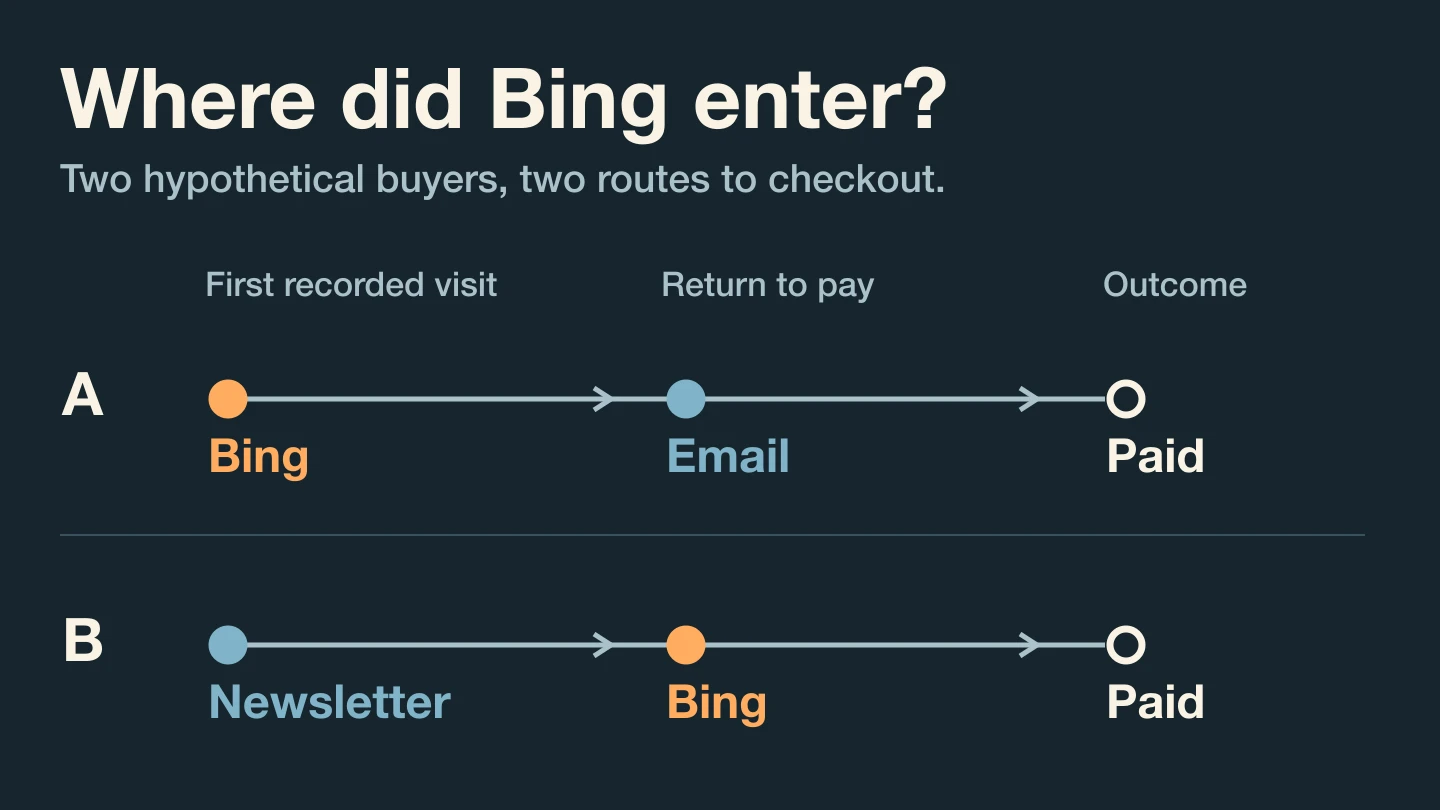
Which buyer first arrived through Bing?
Here is a hypothetical follow-up batch. Twelve new single-user accounts each had 14 full days after signup to pay. Count each account’s first successful payment once. Two accounts paid.
| Buyer | First recorded visit | Session when they paid | What they remember |
|---|---|---|---|
| A | Bing organic → payroll export page | Product email → checkout | Searched for a way to export shifts. |
| B | Trade newsletter → product page | Bing organic → pricing | Looked up the product by name to get back. |
Bing appears in both histories. A is evidence that search can introduce someone with the payroll problem. B gives you a reason to check whether a returning buyer can find pricing by name. Under a first-recorded-source rule, Bing gets one new paying account. Counting B as another Bing acquisition would hide the newsletter’s role.
Now include the ten accounts that did not pay. Five of the twelve first arrived through Bing organic, four through the newsletter and three had an unknown first source. A was the only payer in the first group. The observed result is 1 of 5 Bing-first signups paid within 14 days. That denominator excludes people who visited without signing up. One more paying account in the same five would move the fraction from 20% to 40%. This batch is too small to budget against either rate.
Pick the page you can test
In Bing Webmaster Tools, open Search Performance for the period containing the visit. Inspect the landing page and the search terms reported for it, matching the dates and traffic scope where available. Keep branded searches and job-specific searches separate. Bing documents comparisons across clicks, impressions, keywords and pages. Those aggregates can suggest questions to investigate. They cannot tell you which query belonged to customer A. Bing’s Search Performance guide
For A’s route, try the payroll page yourself. Can a café manager see the exported columns and tell whether the file will work for their payroll system? If that information is missing, add a downloadable example with fictional shifts and the actual supported columns. Record the change date. For B’s route, try finding the price and returning to checkout. If that path works, B’s sale alone gives you little reason to commission more articles about payroll.
If you are considering a separate landing page, check whether the searcher needs a different deliverable. Bring the anonymized journeys and your proposed change to Ilias Ism’s AI mentor to choose the next search experiment ↗.
Track the next comparable batch through the same 14-day window. Count eligible signups, accounts that export a usable file, and accounts that pay. If other Bing-first customers complete the export and describe the same need, you have a reason to keep improving that path. If people arrive but cannot use the file, inspect one failed export with their permission. If very few eligible accounts arrive, keep collecting observations before judging the edit. Calendar comparisons can guide your next test even when they cannot establish that the edit caused a sale.